In Search of Jules Verne by Kelly Gabriel Lee
Returning to Paris a little more than ten years after my initial visit (a lapse that I equate as an unfortunate form of cultural comatose) instilled in me sense of irrepressible excitement. Prompted by an invitation to attend my niece’s wedding in a chateau outside the city (so Perrault-esque!) and coerced into extending my stay to two weeks due to the restrictive availability of flights using mileage, I decided that my trip would not only embrace “La Ville-Lumière,” but also a few other destinations of notable incandescence. Here was my chance, I thought, of visiting places in France connected to Jules Verne, both historically and spiritually, while also returning to those sights in Paris that are de rigueur even for the most jaded repeat traveler. Of course, I would also take in a few museums and places that escaped my attention the first time around. Along with the obligatory visits to the Louvre, Musée d’Orsay, Notre Dame, Sacré Coeur, Rodin Museum, Musée du Quai Branly, Versailles, et al., I also made plans to visit Amiens, Verne’s home for the final period of his life, and Nantes, where he lived as a boy. Booking a Eurail pass was done right after I secured my flight.
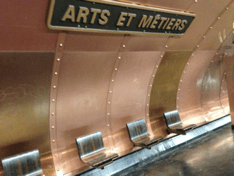
High on my Parisian to-do list was the Musée d’Arts et Métiers, the museum of industrial design that houses an astounding collection of scientific instruments and inventions. I was delighted to discover that the museum is just a few feet (or meters, I should say) from my absolutely favorite metro station in all of Paris, Arts et Métiers. Redesigned in 1994 in a steampunk style that evokes several of the science fiction works of Jules Verne, the station’s walls and ceilings are covered entirely with faux copper. That the glistening surface also features portholes (containing miniature replicas of machines) invariably conjures up the interior of the Nautilus from Verne’s classic tale, 20,000 Leagues Under the Sea. Sitting in the station coincidentally wearing a stripped nautical T-shirt while several of the trains on the 11 line arrived and departed, I could not help but feel as if I were a member of Captain Nemo’s crew! I wondered, would I eventually encounter a giant squid? (Answer to follow . . .)

While the Musée d’Arts et Métiers, located in the renovated Saint-Martin-des-Champs abbey, does not boast a submarine of any type or scale, it nonetheless has an astounding collection of early navigational instruments (compasses, sextants, and telescopes, along with lots of clocks and chronometers) that could easily have been in the dexterous hands of Captain Nemo, as well as Phileas Fogg and other Verne protagonists. Often breathtakingly elegant, these instruments, consisting of glistening components of glass and brass, of polished wood and gleaming metal, suggest a forgotten era of global exploration and discovery.
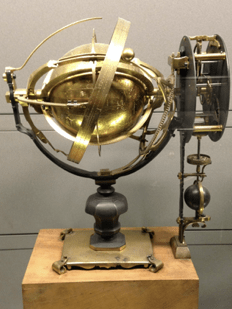
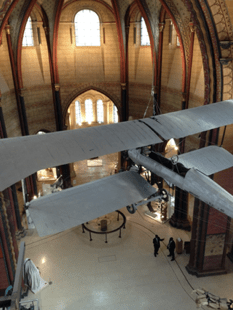
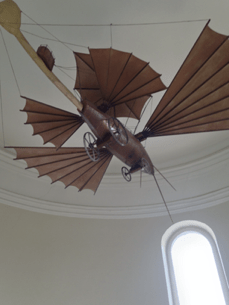
While the display area for Scientific Instruments (“devices to measure, time and space, mathematical instruments”) alone is enough to merit a visit, of equal attraction is the small collection of automatons and the huge Mechanics Domain, with its display of mechanisms and early methods of transmitting movement using levels, pulleys, ball bearings, and gears – très steampunk et très Verne! Just make sure you don’t miss Foucault’s Pendulum in the chapel, with the beautiful late 19th-century airplanes suspended overhead, before you leave.
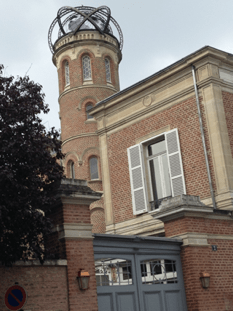
In Verne’s home in Amiens, a quick trip by train north of Paris, I found actual as well as recreated items belonging to the author that testify to his restless globetrotting spirit. The self-guided tour of this attractive brick house, with its commanding tower, begins in the glass-enclosed winter garden and takes one through a succession of dining room/drawing room/smoking room before entering a library dedicated to Verne’s travels and theater writings.
A spiral cast-iron staircase led me to the next level, which boasts an impressive library showcasing the publications of Pierre-Jules Hetzel, Verne’s editor. They include leather-bound editions of Voyages Extraordinaires with their gilded and intricately designed covers; also on display are posters, illustrations, and other documents concerning the novels. Sharing the floor are Hetzel’s study and a room honoring Verne’s dedication to civic life in Amiens, along with his love of the circus.
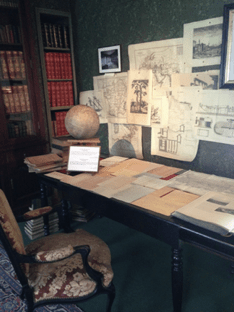
On the next level, I strolled through a replicated cabin of ones of Verne’s yachts, the Saint-Michel III, where he spent countless hours sailing and drifting when not penning his manuscripts. Down the corridor is a large room dedicated to Around the World in Eighty Days and Verne’s love of geography. An enormous map of the world covers the floor, tracing the voyage taken by Robur the Conqueror. In one corner sits a recreation of Verne’s library, his desk and wall cluttered with books and maps used for research, along with a telescope and globe. At the far end of the room, I glimpsed into a more private study, equipped with a desk and a small bed, where Verne wrote many of his novels.

On the landing at the foot of the stairs leading to the attic, I passed by a wealth of movie posters, illustrations, and other ephemera (i.e., paperback novels from around the globe) celebrating the author’s work. Also hanging on the wall is a newspaper clipping announcing his death in 1905, accompanied by a photo of him on his deathbed and the funeral procession. Even with such a somber sight, the tour through Verne’s life had not ended. In the attic, I found a treasure trove, arranged in deliberate disarray, of countless items commemorating the many film adaptations of Verne’s stories, along with puppet shows, trunks and baskets filled with broadsheets and magazines, musical scores, yet more movie posters, and – suspended from the beams – wonderful models of fantastic vehicles featured in his narratives. Taking the circular stairway down through the tower, my final image was that of the flying machine from Master of the World, hanging overhead. The memory and rich legacy of Jules Verne is without doubt still alive in Amiens.
It was therefore an astounding discovery to find Verne’s inventive spirit equally alive, if not more so, in Nantes, his childhood home. With only a day and a half available, I could only partially follow “In the Footsteps of Jules Verne,” as outlined in a brochure handed out by the tourist office. With the Musée Jules Verne closed during my first day, I instead headed for the Les Machines de L’Île, without doubt one of the most spectacular sights anywhere. Described as “the crossroads where the invented worlds of Jules Verne, the mechanical universe of Leonardo da Vinci and the industrial history of Nantes meet,” Les Machines de L’Île is a total and impressive art project occupying a former naval shipyard.
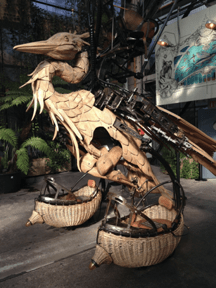
The Galerie des Machines houses a menagerie of large mechanical animals – some able to transport humans on their backs – and include a heron with a massive wingspan and a giant ant and caterpillar.
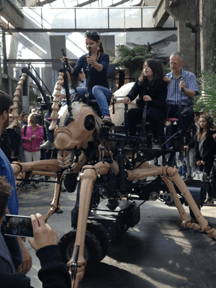
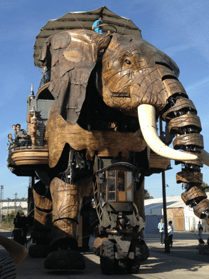
Nothing, however, quite prepared me for the Grand Éléphant, an astounding mechanical pachyderm as tall as a 4-story house, able to transport over a dozen enthralled passengers. Like “architecture in motion,” the creature lumbered down the walkway, rolling its head, twitching its ears, and spraying water from its writhing trunk.
Smaller in scale, but equally deserving of attention for their brilliant sculptured craftsmanship are the aquatic creatures found in the Carrousel des Mondes Marins (the Marine Worlds Carousel). Spinning around on three levels, this “360-degree theater” offers a delightful spectacle of sea animals, both wondrous and monstrous. The giant squid, seemingly inspired by Verne’s 20,000 Leagues Under the Sea, caught my eye first, followed by the huge crab, featured in more than one cinematic version of The Mysterious Island, and the giant sea serpent.
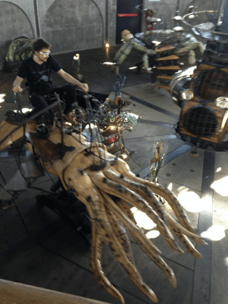
I was most mesmerized by the menacing beauty of the seahorses.Chatting a bit with Maxim, who operates the carousel and speaks English almost fluently, I learned that Verne and a steampunk sensibility are indeed fundamental to the entire attraction as conceived by its creators.

While visitors are allowed to view the activities of the workshop (adjacent the Galerie), where the creatures are designed and constructed, the artists were currently in China as part of an international tour. I ended my visit of Les Machines de L’Île by dining on grilled prawns at the café, a tasty if slightly ironic finish to a thrilling afternoon spent in the undersea world of Jules Verne.
The next morning was reserved for the Jules Verne Museum, although with one brief stop beforehand. On the opposite shore of the river and a couple of tram stations past Les Machines de L’Île is a small setting on which stands the commanding figure of Captain Nemo, looking toward the sea through a sextant. Behind him sits the young Jules Verne, looking pensive and with just a glimmer of the incredible imagination from which would emerge some of literature’s most memorable stories and characters. These marvelous bronze statues (created in 2005) stand just below the Jules Verne Museum, which rests on a bluff overlooking the Loire.

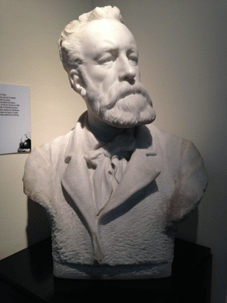
While the museum lacks the biographical scope and depth of the collection found at the Verne home in Amiens, it nonetheless pays fond tribute to the author’s oeuvre. A handsome bust of Verne greeted me at the start of the exhibit, and I quickly found myself looking over the displays evoking his most popular works. 20,000 Leagues was best represented, with an assortment of nautical artifacts, book illustrations, a diving outfit, and a miniature model of the Nautilus, its interior exposed to show the various chambers. Also on view are diagrams of the spaceship featured in From the Earth to the Moon, a set of dioramas depicting scenes from Michael Stragoff, Spanish movie posters for Master of the World, and a board game based on Around the World in Eighty Days.
The final display showcases an array of more recent items honoring Verne and his stories, demonstrating the man’s unshakeable presence in popular culture as well as literature – ranging from a wine label to bags of coffee, playing cards to puzzles, porcelain plates to toy figures. For sale, just a few feet away, were a surprising number of books and publications, along with postcards, playing cards, and other tchotchkes – enough to please any avid J.V. fan with a pocket full of euros (and hopefully room in his suitcase) to spare. With a smile and a sigh, I bid farewell to Verne and the delightful city of Nantes and headed for the train station for my return trip to Paris.

 Kelly Gabriel Lee